

1·
3 days agoI’ll DM you… Not sire I want to link those two accounts publicly 😄
I’ll DM you… Not sire I want to link those two accounts publicly 😄
Zero.
About 35 NixOS VMs though, each running either a single service (e.g. Paperless) or a suite (Sonarr and so on plus NZBGet, VPN,…).
There’s additionally a couple of client VMs. All of those distribute over 3 Proxmox hosts accessing the same iSCSI target for VM storage.
SSL and WireGuard are terminated at a physical firewall box running OpnSense, so with very few exceptions, the VMs do not handle any complicated network setup.
A lot of those VMs have zero state, those that do have backup of just that state automated to the NAS (simply via rsync) and from there everything is backed up again through borg to an external storage box.
In the stateless case, deploying a new VM is a single command; in the stateful case, same command, wait for it to come up, SSH in (keys are part of the VM images), run restore-<whatever>.
On an average day, I spend 0 minutes managing the homelab.
You (sadly) need to group all quality profiles into a single one, and then handle quality through a custom format. Example from my setup:

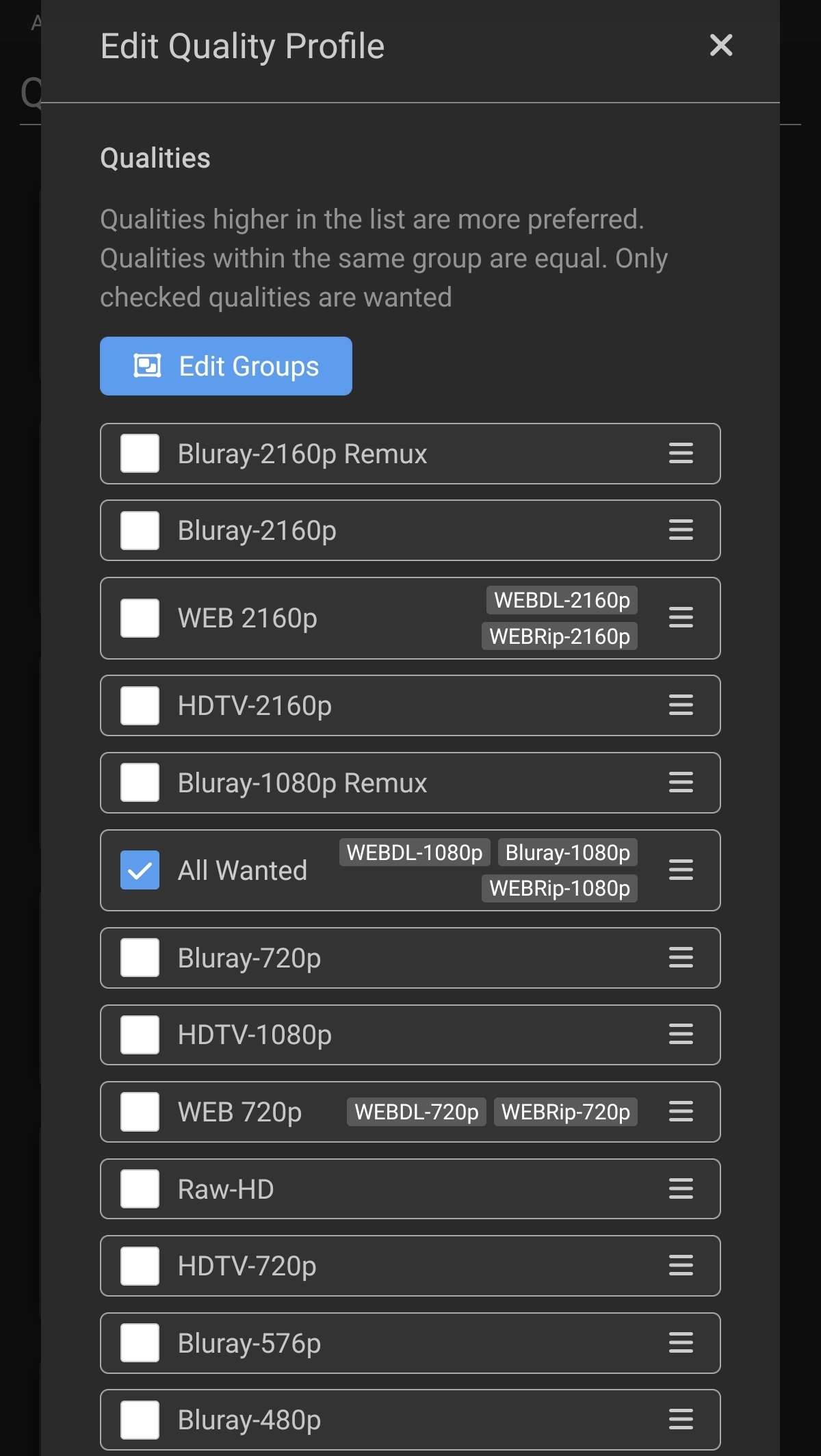
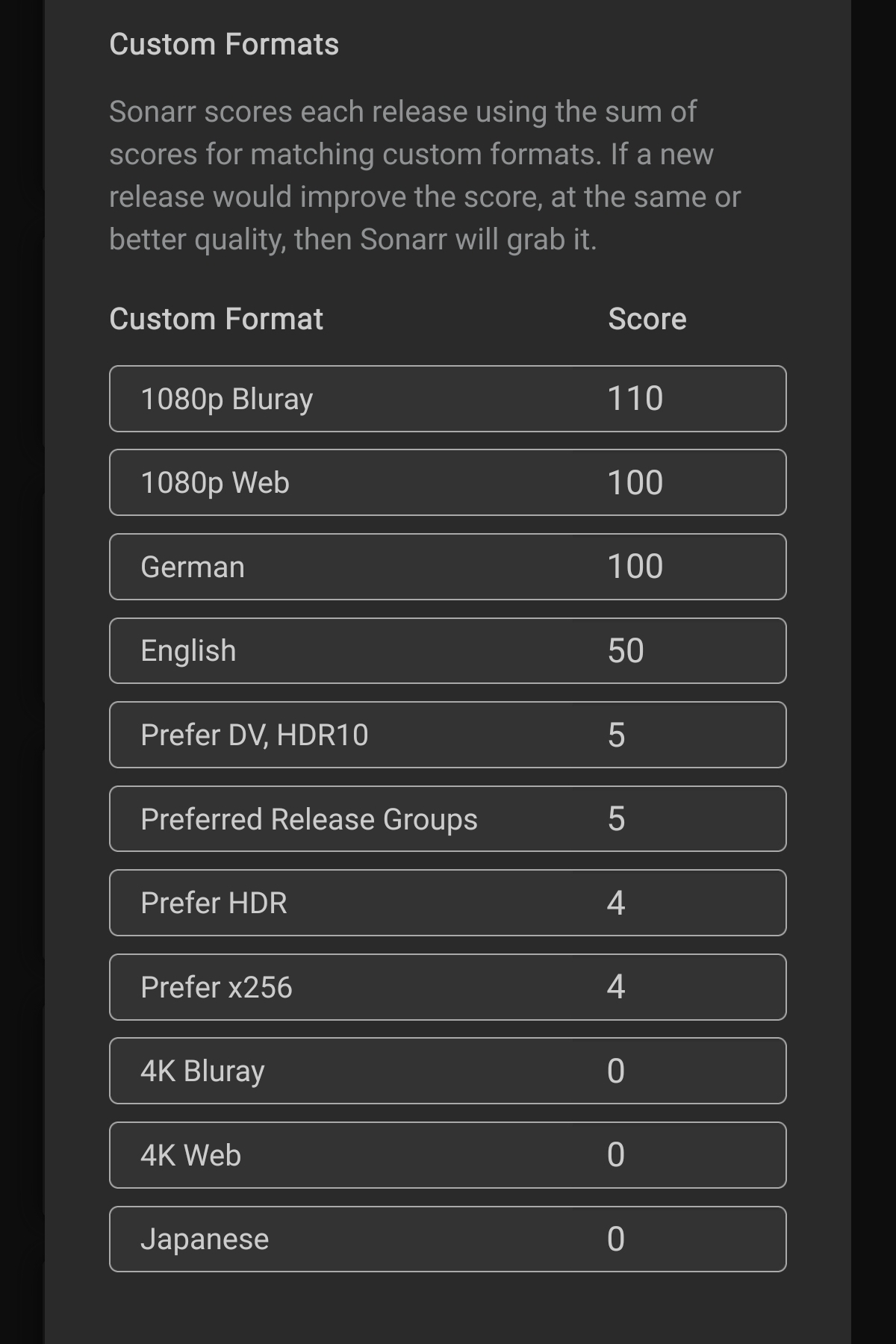
NixOS for the win! Define your system and services, run a single command, get a reproducible, Proxmox-compatible VM out of it. Nixpkgs has basically every service you’d ever want to selfhost.
Lost me at LLMs. My Nix config is over 20k lines long at this point, neatly split into more than a hundred modules and managing 8 physical machines and 30+ VMs. I love it.
But every time I’ve tried to use an LLM for nix, it has failed spectacularly.
Sorry, unfortunately can’t help you there. My matrix server is not federated, I remember back then I created an account on matrix.org specifically to read these. But maybe they got deleted in the meantime?
Anyways, I have been really happy with continuwuity, to the point that up until now, I haven’t even looked at tuwunel again. The maintainers of continuwuity seem really nice and engaged, and both from a usage and stability point of view, as well as for the actually surprisingly fast release cycle, I have no complaints. I found and fixed a bug a couple weeks ago, and the dev process was also very friendly and relaxed.
In short: while I don’t know how things are on the tuwunel side, I’m very happy to have gone with continuwuity and have high hopes for the future of the project.

You do have a point. TBH I only now realized that the video was posted from Doctorow’s personal account, and without a link to the “original”, which yeah, kinda weird.
The talk itself is still worth it (had the fortune of sitting in the audience), but probably a good idea to use the media.ccc.de link.
Originally/additionally hosted on media.ccc.de
FWIW, I’ve been using Music Assistant with my Sonos speakers without issue.
HOWEVER, I’m using MA as part of Home Assistant, and have the speakers configured through HA, not MA. MA just sees the speakers as HA Media Players. That works really well.
Almost 9k lunes of python in a bash script. Lmao. No.
Matrix will not be affected. At all.
CP is just a pretext here.
Oh, sorry, I did not mean to imply that there re no players (there are, e.g. Finamp), just nowhere near the same level of polish, features and stability.
Jellyfin doesn’t have something comparable in the dedicated (OSS) world, but Symfonium takes a Jellyfin connection and is hands down the single best music player I have ever encountered on any platform.
The number of recent updates, it seems. Which is probbaly an OK metric.
Graphene explicitly says the 400k are worldwide. You cannot then go ahead and use the US numbers for your comparison. From your own source, Google shipped 10 million Pixel 9 devices in 2023 alone. This does not account for other/older pixel models, or the sum total of sales before that point, or since.
Why not just share the actual number: worldwide, there’s 400k users.
Surfshark does too
So do many others, I’d assume
Planning to host a Nix caching server, and have CI build all package and NixOS outputs on every push to git, then in turn pushing the output artifacts to the cache. Would save me a good chunk of time when tinkering with VMs that haven’t seen manual updates in a while.
Only thing is, I’m not sure how to approach building and caching NixOS configs that receive agenix secrets in their input. Obviously those should not be cached…
Yes, and I do werether the recipient also knows how to use it.
So, for like, 1% of my mails.
More like: paying someone to maintain the hardware.
Anyways.
Just FYI, your mails with a provider like Proton are not E2E encrypted unless you exclusively wrote with other Proton customers (in which case I assume they are. No idea). Otherwise it’s just encrypted at rest.
I dint really see the benefit over doing it completely yourself, not even offering metadata to a provider, and also having encryption at rest, while maintaining full compatibility with mail clients 🤔
Eh… Not really. Qemu does a really good job with VM virtualizarion.
I believe I could easily build containers instead of VMs from the nix config, but I actually do like having a full VM: since it’s running a full OS instead of an app, all the usual nix tooling just works on it.
Also: In my day job, I actually have to deal quite a bit with containers (and kubernetes), and I just… don’t like it.