Your obviously is only a convention and not everyone agree with that. Not even all peogramming languages or calculators.
If you wanted obviously, it would have to have different order or parentheses or both. Of course everything in math is convention but I mean more obvious.
2+2*4 is obvious with PEDMAS, but hardy obvious to common people
2+(2*4) is more obvious to common people
2*4+2 is even more obvious to people not good with math. I would say this is the preferred form.
(2*4)+2 doesn’t really add more to it, it just emphasises it more, but unnecessarily.
Honestly that’s my pet peeve about this category of content. Over the years I’ve seen (at least) hundreds of these check-out-how-bad-at-math-everyone-is posts and it’s nearly always order of operations related. Apparently, a bunch of people forgot (or just never learned) PEMDAS.
Now, having an agreed-upon convention absolutely matters for arriving at expected computational outcomes, but we call it a convention for a reason: it’s not a “correct” vs “incorrect” principle of mathematics. It’s just a rule we agreed upon to allow consistent results.
So any good math educator will be clear on this. If you know the PEMDAS convention already, that’s good, since it’s by far the most common today. But if you don’t yet, don’t worry. It doesn’t mean you’re too dumb to math. With a bit of practice, you won’t even have to remember the acronym.
Most actual math people never have to think about pemdas here because no one would ever write a problem like this. The trick here is “when was the last time I saw an X to mean multiplication” so I would already be off about it
1 + 1/2 in my brain is clearly 1.5, but 1+1÷2 doesn’t even register in my brain properly.
Right, and that clue IMO unravels the more troubling aspect of why this content spreads so quickly:
It’s deliberately aimed at people with a rudimentary math education who can be made to feel far superior to others who, in spite of having roughly the same level of proficiency, are missing/forgetting a single fact that has a disproportionate effect on the result they expect.
That is, it’s blue-dress-level contentious engagement bait for anyone with low math skills, whether or not they remember PEMDAS.
“No one” in this context meant “no one who actually does maths professionally.”
In a Maths textbook
Right, and I have decades of maths experience outside of textbooks. So it’s probably been 20 years since I had a meaningful interaction with the × multiplication symbol.
You don’t know that the obelus means divide??
I clearly know what the symbol means, I demonstrated a use of it. But again, haven’t had a meaningful interaction with the symbol in 20 years, and yet I deal with / for division daily.
When I see 1+½ i can instantly say “one and a half”, but when I see 1 + 1 ÷ 2 i actually have to pause for a moment to think about order of operations. Same with 1+2x vs 1 + 2 × x … one I recognize the structure of the problem immediately, and one feels foreign.
The point is that people who do maths for a living, and are probably above average in maths, tend to write things differently than people who are stopped their maths education in high school (or lower), and these types of memes are designed around making people who know high school maths feel smart. People who actually know maths don’t need memes to justify being better at maths than the rest of the public.
just stop it it’s not cool its not funny its not impressing everyone and you’re just going to feel badly about it later so stop it now before it gets worse just fucking stop it
I’m not sure what motivates you to so generously offer your various dyadic tokens of knowledge on this subject without qualification while ignoring my larger point, but will assume in good faith that your thirst for knowledge rivals that of your devotion to The Rules.
First, a question: what are conventions if not agreed upon rules? Second, here is a history of how we actually came to agree upon the aforementioned rules which you may find interesting:
I’m a Maths teacher with a Masters - thanks for asking - how about you?
while ignoring my larger point
You mean your invalid point, that I debunked?
what are conventions if not agreed upon rules?
Conventions are optional, rules aren’t.
here is a history of how we actually came to agree upon the aforementioned rules which you may find interesting
He’s well-known to be wrong about his “history”, and if you read through the comments you’ll find plenty of people telling him that, including references. Cajori wrote the definitive books about the history of Maths (notation). They’re available for free on the Internet Archive - no need to believe some random crank and his blog.
By qualification I meant explanation. My doctorate is irrelevant to the truth.
Since you asked, my larger point was about the unhelpful nature of this content, which makes students of math feel inordinately inferior or superior hinged entirely on a single point of familiarity. I don’t handle early math education, but many of my students arrive with baggage from it that hinders their progress, leading me to suspect that early math education sometimes discourages students unnecessarily. In particular, these gotcha-style math memes IMO deepen students’ belief that they’re just bad at math. Hence my dislike of them.
Re: Dave Peterson, I’ll need to read more about this debate regarding the history of notation and I’ll search for the “proven rules” you mentioned (proofs mean something very specific to me and I can’t yet imagine what that looks like WRT order of operations).
If what riled you up was my use of the word “conventions” I can use another, but note that conventions aren’t necessarily “optional” when being understood is essential. Where one places a comma in writing can radically change the meaning of a sentence, for example. My greater point however has nothing to do with that. Here I am only concerned about the next generation of maths student and how viral content like this can discourage them unnecessarily.
It sure is. I’ve seen a PhD who didn’t read the only textbook he had referenced in his thesis, which proved his idea that teachers were doing it wrong and he wasn’t, was wrong. 😂 Should’ve listened to the people who teach it (or actually read the textbook he referenced 🙄 ).
which makes students of math feel inordinately inferior
They don’t. All students get this correct. It’s only adults who have forgotten the rules that get it wrong.
these gotcha-style math memes IMO deepen students’ belief that they’re just bad at math
Nope. Students never get these wrong.
proofs mean something very specific to me and I can’t yet imagine what that looks like WRT order of operations
All you have to do is see which way gives wrong answers for 2+3x4 and you’ve proven which ways don’t work 😂
note that conventions aren’t necessarily “optional”
Yes they are.
when being understood is essential
You don’t understand how to do 2+3x4-5 without knowing which conventions people use for the order of the plus and minus?
Here I am only concerned about the next generation of maths student and how viral content like this can discourage them unnecessarily
I feel like people should at least remember math at a 4th grade level and be able to get 10. What is the point of making it obvious the universe will never ever arrange itself in such a fashion. The point is if you remember simple rules you applied for a 10-15 years.
You’ve completely not understood that order of operations is an arbitrary convention. How did you decide to expand the definition of multiplication before evaluating the addition? Convention.
You can’t write 2 + 2 ÷ 2 like this, so how are you gonna decide whether to decide to divide or add first?
How are you gonna write 2 + 2 ÷ 2 with repeated addition?
The definition of Multiplication as being repeated addition
That doesn’t mean it has to be expanded first. You could expand 2 + 2 × 3 as (2+2)+(2+2)+(2+2) and you are unable to tell me what mathematical law prohibits it.
If this were a universal law, reverse polish notation wouldn’t work as it does. In RPL, 2 2 + 3 × is 12 but 2 3 × 2 + is 8. If you had to expand multiplication first, how would it work? The same can be done with prefix notation, and the same can be done with “pre-school” order of operations.
Different programming languages have different orders of operations, and those languages work just fine.
Your argument amounts to saying that it makes the most sense to do multiplication before addition. Which is true, but that only gives you a convention, not a rule.
How are you gonna write 2 + 2 ÷ 2 with repeated addition?
You don’t, because the second 2 is associated with a Division that has to be done before the addition. Maybe go back to school and learn how to do Maths 🙄
That doesn’t mean it has to be expanded first.
Yes it does. Everything has to be expanded before you do the addition and subtraction, or you get wrong answers 🙄
2+3x4=2+3+3+3+3=2+12=14 correct
2+3x4=5x4=5+5+5+5=20 wrong
You could expand 2 + 2 × 3 as (2+2)+(2+2)+(2+2)
Says someone who can’t tell the difference between (2+2)x3=12 and 2+2x3=8 🙄
you are unable to tell me what mathematical law prohibits it
The order of operations rules 😂
reverse polish notation wouldn’t work as it does
It works because it treats every operation as bracketed without writing the brackets. Also that’s only a Maths notation, not the Maths itself.
In RPL, 2 2 + 3 × is 12
Because the way it calculates that is (2+2)x3, not complicated. Same order of operations rules as other Maths notations - just a different way of writing the same thing
If you had to expand multiplication first, how would it work?
It works because Brackets - 2 2 + = (2+2) - are before Multiplication
The same can be done with prefix notation
Another Maths notation, same rules of Maths
Different programming languages have different orders of operations
You don’t, because the second 2 is associated with a Division that has to be done before the addition. Maybe go back to school and learn how to do Maths 🙄
Right, so you cannot derive precedence order from the definition of the operations. Your argument based on the definition of multiplication as repeated addition is wrong.
or you get wrong answers
This is begging the question. We are discussing whether the answers are flat wrong or whether there is a layer of interpretation. Repeating that they are wrong does nothing for this discussion, so there’s no need to bother.
You have nothing to say that I can see about why the different interpretations are impossible, or contradictory, or why they ought to qualify as “wrong” even though maths works regardless; you’ve just heard a school-level maths teacher tell you it’s done one way and believe that’s the highest possible authority. I’m sorry, but lots of things we get taught in high school are wrong, or only partially right. I see from your profile that you are a maths teacher, so it’s actually your job to understand maths at a higher level than the level at which you teach it. It may be easier to to teach high school maths this way, but it’s not a good enough level of understanding for an educator (or for a mathematician).
Left to right is a convention (as is not writing the brackets in RPN). Brackets before Multiplication before Addition are rules.
OK, let’s try a different tack. When I hear the word “rules”, I think you’re talking either about a rule of inference in first order logic or an axiom in a first-order system. But there is no such rule or axiom in, for example, first order Peano arithmetic. So what are you talking about? Can you find somewhere an enumeration of all the rules you’re talking about? Because maybe we’re just talking at cross-purposes: if you deviate from the axioms of Peano arithmetic then we’re fundamentally not doing arithmetic any more. But I contend that you will not find included in any axiomatisation anything which specifies order of operations. This is because from the point of view of the “rules” (i.e. the axioms) the addition and multiplication operations are just function symbols with certain properties. Even the symbols themselves are not really part of the axiomatisation; you could just as well get rid of the + symbol and write A(x, y, z) instead of “x + y = z”; you’d have the exact same arithmetic, the exact same rules.
If you’re able to answer this, we can get away from these vague terms which you keep introducing like “notation definition”, and we can instead think about what it means to be a convention versus whatever it is you mean by “rule”. (For example, Peano arithmetic has a privileged position amongst candidates for arithmetic because it encompasses our intuition about how numbers work: you can’t just take an alternative arithmetic, like say arithmetic modulo 17, and say that’s an “alternative convention” because when you add an apple to a bowl of 16 apples, they don’t all disappear. But there’s no such intuition about how to write mathematics to express a certain thing. I contend that is all convention.)
It works because it treats every operation as bracketed without writing the brackets. Also that’s only a Maths notation, not the Maths itself.
So, you understand that a notation can evaluate things in a certain order with what you call “treating every operation as bracketed without writing brackets.” What does it mean to be “bracketed without writing brackets”? There are exactly two aspects to brackets:
the symbols themselves - but we’re not writing them! So this isn’t relevant.
the effect they have - the effect on the order of evaluation of operations
So what you’re admitting with these phantom brackets is that a notation can evaluate operations in a different order, even though there are no written brackets.
So I can specify these fake brackets to always wrap the left-most operation first: (2 + 3) x 5 and hey look, this notation now has left-to-right order of evaluation, not the usual multiplication first. If you prefer to think of there being invisible brackets there, go right ahead, but the effect is the same.
So, how do we decide whether our usual notation “has bogus brackets” or not? Convention. We could choose one way or the other. Nothing breaks if we choose one or the other. Symmetrically, we could say that left-to-right evaluation is the notation “without bogus brackets” and that BODMAS evaluation is the notation “with bogus brackets”. Which choice we make is entirely arbitrary. That is, unless you can find a compelling reason why one is right and the other wrong, rather than just saying it once again.
They don’t actually. Welcome to most e-calcs give wrong answers because the programmers failed to deal with it correctly.
What problems does it cause? Are the problems purely that they don’t have the order of operations you expect, and so get different answers if you don’t clarify with brackets? Because that, again, is begging the question.
To re-iterate, you are in a discussion where you’re trying to establish that it’s a fundamental law of maths that you must do multiplication before addition. The fact that you’ve written a post in which you document how some calculators don’t follow this convention and said that they’re wrong is not evidence of that. It’s just your opinion. Indeed, it’s really (weak) evidence that your opinion is wrong, because you’re less of an authority than the manufacturers of calculators.
On calculators, there’s something important you need to realise: basic, non-scientific, non-graphing calculators all have left-to-right order of operations. You can test this with e.g. windows calculator in “standard” mode by typing 2, +, 3, x, 5 (it will give you 25, not 17). Switch it to “scientific” mode and it will give you 17.
Why is it different? Because “standard” mode is emulating a basic calculator which has a single accumulator and performs operations on that accumulated value. When you type “x 2” you are multiplying the accumulator by 2; the calculator has already forgotten everything that you typed to get the accumulator. This was done in the early days of calculators because it was more practical when memory looked like this:
Now, you can go on about your bogus brackets until you’re blue in the face, but the fact is that this isn’t “wrong”. It has a different convention for a sensible reason and if you expect something different then it is you who are using the device wrong.
From your other comment, since having two threads seems pointless:
So if you have one “notation definition” as you call it which says that 2+2*3 means ”first add two to two, then multiply by three” and another which says “first multiply two by three, then add it to two”, why on earth do the “rules” have anything further to say about order of operations?
No we don’t. We have another notation which says to do paired operations (equivalent to being in brackets) first.
What do you mean “we don’t”? I just made the definition. It exists. This is why terms like “notation definition” are not actually helpful IMO, so let’s be precise and use terms that are either plain english (like “convention”) or mathematical (like “axiom”, “definition”, etc).
Right, so you cannot derive precedence order from the definition of the operations.
Yes you can. I’m not sure what you’re not understanding about Division before Addition 😂
Your argument based on the definition of multiplication as repeated addition is wrong
No it isn’t! 😂
We are discussing whether the answers are flat wrong or whether there is a layer of interpretation
Flat wrong, as per the rules Of Maths 🙄
Repeating that they are wrong does nothing for this discussion, so there’s no need to bother
So stop doing wrong things and I can stop saying you’re doing it wrong 😂
why they ought to qualify as “wrong” even though maths works regardless
If you have 1 2 litre bottle of milk, and 4 3 litre bottles of milk, even a 3rd grader can count up and tell you how many litres there are, and that any other answer is wrong. 🙄 2+3x4=2+3+3+3+3=14 correct 2+3x4=5x4=5+5+5+5=20 wrong See how the Maths doesn’t work regardless? 😂
you’ve just heard a school-level maths teacher tell you it’s done one way and believe that’s the highest possible authority
Nope, I’ve proven it myself - that’s the beauty of Maths, that anyone at all can try it for themselves and find out. I’m guessing that you didn’t try it yourself 😂
lots of things we get taught in high school are wrong
says person failing to give a single such example 🙄
it’s actually your job to understand maths at a higher level than the level at which you teach it
No it isn’t. I’m required to to get the Masters degree which is required to be a teacher here, and that’s the end of it.
It may be easier to to teach high school maths this way
The correct way, yes 😂
When I hear the word “rules”, I think you’re talking either about a rule of inference in first order logic or an axiom in a first-order system
Nope, neither.
So what are you talking about?
What don’t you understand about 20 being a wrong answer for 2+3x4??
whatever it is you mean by “rule”
Thing which results in wrong answers if disobeyed - like 2+3x4=20 - not complicated. This is what we teach to students - if you always obey all the rules then you will always get the correct answer.
arithmetic modulo 17, and say that’s an “alternative convention”
Of course not, just a different function of Maths, that doesn’t involve Arithmetic at all (other than the steps along the way in doing the long division), unlike 2+3x4 🙄
I contend that is all convention
Nope! Just a different rule to Arithmetic 🙄
What does it mean to be “bracketed without writing brackets”?
Same thing as we’re adding the 2 in 2+3 without writing a plus (or a zero) in front of the 2 - all Arithmetic starts from zero on the number-line. Maths textbooks explicitly teach this, that we can leave the sign omitted at the start if it’s a plus.
the symbols themselves - but we’re not writing them! So this isn’t relevant
Just like we aren’t writing the plus sign in 2+3 🙄
So what you’re admitting with these phantom brackets is that a notation can evaluate operations in a different order, even though there are no written brackets.
Nope. Same order as though we did write it in a notation using Brackets, same as we always start with adding the 2 even though we didn’t write a plus sign in 2+3.
So I can specify these fake brackets to always wrap the left-most operation first: (2 + 3) x 5
No you can’t, because you get a wrong answer 🙄
this notation now has left-to-right order of evaluation
No it doesn’t, Multiplication before Addition 🙄
If you prefer to think of there being invisible brackets there
You know we were writing this without brackets for several centuries before we started using brackets in Maths, right?? 😂
So, how do we decide whether our usual notation “has bogus brackets” or not? Convention
Nope. proven rules 🙄
We could choose one way or the other.
No we can’t. Even a 3rd grader who is counting up can tell you that 🙄
Nothing breaks if we choose one or the other.
Yes it does. Again ask the 3rd grader how many litres we have, and then try doing Addition first to get that answer 😂
we could say that left-to-right evaluation is the notation “without bogus brackets”
No we can’t. Ask the 3rd grader, or even try it yourself with Cuisenaire rods
Which choice we make is entirely arbitrary
Nope. proven rules 🙄
That is, unless you can find a compelling reason why one is right and the other wrong, rather than just saying it once again
Count up how many litres we have 🙄
What problems does it cause?
wrong answers 😂
you’re trying to establish that it’s a fundamental law of maths that you must do multiplication before addition
As per Maths textbooks 😂
you’ve written a post in which you document how some calculators don’t follow this
rule
said that they’re wrong is not evidence of that
says person ignoring the Maths textbooks I quoted and the actual calculators giving the correct answer 🙄
It’s just your opinion
Nope! proven rules as found in Maths textbooks 🙄
it’s really (weak) evidence that your opinion is wrong,
says person ignoring the Maths textbooks I quoted and the actual calculators giving the correct answer 🙄
you’re less of an authority than the manufacturers of calculators
Demonstrably not 😂
basic, non-scientific, non-graphing calculators all have left-to-right order of operations
No they don’t! 😂
e.g. windows calculator in “standard” mode
The Windows calculator is an e-calc which was written by a programmer who didn’t check that their Maths was correct. 🙄 Now try it with any actual calculator 🙄
Why is it different?
Written by a different programmer, but one who didn’t know The Distributive Law, so even in Scientific mode it gives wrong answers to 8/2(1+3) 🙄
Because “standard” mode is emulating a basic calculator
No it isn’t. All basic calculators obey Multiplication before Addition, 🙄 and if the programmer had tried it then they would’ve found that out
performs operations on that accumulated value
Instead of using the stack, to store the Multiplication first, like all actual calculators do 🙄
When you type “x 2” you are multiplying the accumulator by 2
No, the dumb programmer is. All actual calculators did the Multiplication first and put the result on the stack
the calculator has already forgotten everything that you typed to get the accumulator
But actual calculators have put that result on the stack 🙄
This was done in the early days of calculators
No it wasn’t. All calculators “in the early days” used the stack
It has a different convention for a sensible reason
Nope, it’s just disobeying the rules of Maths because dumb programmer didn’t check their Maths was correct 🙄
it was more practical when memory looked like this:
And even then the stack existed 🙄
the fact is that this isn’t “wrong”
Yes it is! 😂 Again, ask the 3rd grader to count up and tell you the correct answer
if you expect something different then it is you who
knows the rules of Maths 🙄
What do you mean “we don’t”?
What don’t you understand about “we don’t”?
I just made the definition
Of the notation, not the rules 🙄
We have another notation which says to do paired operations (equivalent to being in brackets) first
And this notation says to do paired operations first, same as if they were in Brackets. You so nearly had it 🙄
plain english (like “convention”)
says person who keeps calling the rules “convention” 🙄
mathematical (like “axiom”, “definition”, etc)
You know we have Mathematical definitions of the difference between conventions and rules, right??
Your habit of snipping replies into tiny segments and replying shortly to each makes the discussion much harder to follow. Try and collect your thoughts into something coherent, if you can.
If you have 1 2 litre bottle of milk, and 4 3 litre bottles of milk, even a 3rd grader can count up and tell you how many litres there are, and that any other answer is wrong. 🙄 2+3x4=2+3+3+3+3=14 correct 2+3x4=5x4=5+5+5+5=20 wrong See how the Maths doesn’t work regardless? 😂
So this is the most interesting thing you’ve said.
In mathematical notation with BODMAS order of operations, you can write your 14 litres of milk as 2 + 3 x 4, sure. But if you had right-to-left order of operations you could just write 2 + (3 x 4). So why is 2 + 3 x 4 the correct way to describe the situation? Writing out a real-life situation in mathematical notation is a question of correctly using the notational conventions to express reality.
Consider another scenario where you have two three litre bottles of milk and two three litre bottles of orange juice - how much liquid do you have in total? With BODMAS order, you could not write this as 2 + 2 x 3 = 8 litres; you’d have to insert brackets: (2 + 2) x 3 = 12 litres. But with left-to-right order you could write this as 2 + 2 x 3 = 12.
So what we have are two scenarios, where one translates readily to BODMAS order without brackets, and the other translates readily to L2R order without brackets. Neither tells you which is the superior or correct order. Neither leads to a contradiction, or problems, or incorrect results, as long as it is interpreted correctly. Yes, if you incorrectly translate my scenario as 2 + 2 x 3 with BODMAS order, you get the wrong answer. But the problem is that you translated the problem into mathematical notation using L2R order, then evaluated the expression using BODMAS order.
I’ll certainly agree that translating the problem with one convention then evaluating that with another is wrong! It leads to answers that don’t reflect reality! But of course, if you translate the problem into mathematical notation with L2R order, then evaluate it with L2R order, you get the right answer, and all is fine.
Nope, I’ve proven it myself - that’s the beauty of Maths, that anyone at all can try it for themselves and find out.
This should be easy for you to verify: pick your axiomatisation and write the proof! Or link it; that’s fine too. But you’ll have a struggle given that order of operations is about notation and that is not a (first-order) mathematical concept.
Unfortunately I suspect you think that your scenario above constitutes a proof. It does not. Here is the mathematical definition of a proof in a first order theory: It is a finite sequence of formulae in the theory, where each formula in the sequence is either an axiom of the theory or follows from one or more previous formulae by some rule of inference. The proof is then said to prove the last formula in the sequence.
There is no room for milk and bottles in a proof, unless they have first order definitions in the language of your theory. But the language of arithmetic only has the symbols for addition, multiplication, successor and zero, plus the logical symbols (quantifiers, and, or, brackets).
So I can specify these fake brackets to always wrap the left-most operation first: (2 + 3) x 5
No you can’t, because you get a wrong answer 🙄
You’re trying to establish that it’s wrong. You’re still begging the question. Maybe you’re referring back to the milk, in which case, see above. Either way though, this is an example of a pointless comment; it’s adding nothing beyond restating what you’re already saying.
No we can’t. Even a 3rd grader who is counting up can tell you that 🙄
Count up how many litres we have
Yes it does. Again ask the 3rd grader how many litres we have, and then try doing Addition first to get that answer 😂
No we can’t. Ask the 3rd grader, or even try it yourself with Cuisenaire rods
Yes it is! 😂 Again, ask the 3rd grader to count up and tell you the correct answer
Your imaginary third-grader would be quite capable of looking at the milk and orange juice and writing down 2 + 2 x 3 = 12 and get the correct answer, if you taught him or her the right-to-left convention.
The Windows calculator is an e-calc which was written by a programmer who didn’t check that their Maths was correct. 🙄 Now try it with any actual calculator 🙄
Demonstrably not 😂
No they don’t! 😂
Instead of using the stack*, to store the Multiplication first, like *all actual calculators do
No, the dumb programmer is. All actual calculators did the Multiplication first and put the result on the stack
But actual calculators have put that result on the stack
No it wasn’t. All calculators “in the early days” used the stack
And even then the stack existed 🙄
Wow, 8 separate replies from you all expressing the exact same thing, and all confidently incorrect.
I have no idea how you have forgotten these old, basic calculators.
So, now we’ve established that you’re confidently incorrect about “all actual calculators” having a stack, and about Windows calculator being “wrong” in its emulation of stackless calculators, let’s bring this back to the point: calculators are perfectly usable even though their order of operations is left-to-right. As I said before: it had a different convention for a sensible reason, and if you expect something different it is you who are using the device wrong. How to use the device is written in the manual, so every user of it can use it correctly.
By the way, if you want to continue this discussion, please acknowledge that you were wrong about this. This is a simple, verifiable matter of fact that you’ve been shown to be wrong about, and if you can’t cough to that then you certainly won’t cough to something more nebulous.
wrong answers
Nope! proven rules as found in Maths textbooks 🙄
As per Maths textbook
says person ignoring the Maths textbooks I quoted and the actual calculators giving the correct answer
So, as above, the different calculators have different conventions. But let’s stick with textbooks. Because you are saying all through this that order of operations is not merely a convention, but a rule. So, it’s not actually about textbooks, is it? Yet they are, in fact, the best resource you have: your spilled milk establishes the opposite of what you want it to, so textbooks are all you have.
So consider, if all the textbooks were edited overnight to teach L2R order of operations, what would happen? Children would learn that to add 2 litres of milk to 3 bottles of 4 litres, they ought to write 2 + (3 x 4), which they would calculate and get 14. They would learn that to add the volume of two three litre bottles to two three litre bottles you would write 2 + 2 x 3 and get 12.
The textbooks are, in fact, how you can see that this is just a convention. If the textbooks changed, only what people write would change. The answers would stay the same.
But the textbooks you’ve been linking haven’t been about order of operations, but about the “primitive meaning of multiplication”. Yet, here are the axioms of arithmetic:
For all x (0 = S(x))
For all x, y (S(x) = S(y) -> x = y)
For all x (x + 0 = x)
For all x (x * 0 = 0)
For all x, y (x + S(y) = S(x + y))
For all x, y (x * S(y) = (x * y) + x)
The axiom schema of induction
There is no “definition of multiplication” here because when you get down to it, definitions are things for human beings, not mathematics. Axiom 6 no more (partly) “defines multiplication” than it (partly) “defines addition.”
You know we have Mathematical definitions of the difference between conventions and rules, right??
There’s a mathematical definition of an axiom in a first order theory, but there’s certainly no mathematical definition of a convention, because a convention is a social construct.
What don’t you understand about “we don’t”?
The definition exists. Saying “we don’t have it” doesn’t make sense. I’ve told it to you, so now you have it; you can choose to ignore it, but that’s just making the choice of convention I’m saying you’re making.
Nope, neither.
So… what is it then?
Same thing as we’re adding the 2 in 2+3 without writing a plus (or a zero) in front of the 2 - all Arithmetic starts from zero on the number-line. Maths textbooks explicitly teach this, that we can leave the sign omitted at the start if it’s a plus.
In first-order arithmetic, the + symbol is a binary operation. We’re not “leaving it out” in front of the 2, because it would make no sense to put it there.
Your repeated talk of “wrong answers” makes it sound like you’re a slave to the test. A test has right and wrong answers, after all, and if you read 2 + 2 x 3 on a test and answer 12 you’d be marked wrong. But your job is to establish not that the answer is wrong in this situation, but that if you changed the test then it would be wrong. How are you going to do that? So far you have not even tried to write down what it would mean for the test to be wrong. But I can lay out my definition of “it’s a matter of convention” easily: It’s a matter of convention because humans have agreed to do it one way even though all of maths, all totalling of milk and orange juice, everything could be done another way, and be consistent with itself and with physical reality. Maybe you can say what you find defective with that.
it would have to have different order or parentheses or both.
Neither. Multiplication is always before Addition, hence “obviously”
Of course everything in math is convention
Nope. The vast majority of it is proven rules
2+(2*4) is more obvious to common people
Weird then how many people were able to get this right without brackets for centuries before we started using brackets in Maths (which we’ve only had for 300 years)
Tell that obvious to over half the population who get this wrong
Way less than half actually. No teachers or students ever get this wrong, only adults who have forgotten the rules, and poll after poll puts this down around 40-45% of adults.
PEMDAS isn’t obvious to “common people”? Why not? It doesn’t seem like an arbitrary convention to me…
If “×” means “groups of,” then “2+2×4” means “two plus two groups of four” which only makes sense, to me, to be read as “two plus two groups of four” rather than “two plus two groups of four”
Sure the order of operations could be arbitrarily different, but I feel like we settled on that order because it simply makes more sense intuitively.
I’m aware of the possibility that it only feels natural and intuitive to me because I was taught that way, but I at least don’t think that applies to this specific example
It didn’t occur to me that the poll may function that way. Does it? I thought this was engagement bait in which the poll’s author lists only wrong answers as options



Your obviously is only a convention and not everyone agree with that. Not even all peogramming languages or calculators.
If you wanted obviously, it would have to have different order or parentheses or both. Of course everything in math is convention but I mean more obvious.
2+2*4 is obvious with PEDMAS, but hardy obvious to common people
2+(2*4) is more obvious to common people
2*4+2 is even more obvious to people not good with math. I would say this is the preferred form.
(2*4)+2 doesn’t really add more to it, it just emphasises it more, but unnecessarily.
Honestly that’s my pet peeve about this category of content. Over the years I’ve seen (at least) hundreds of these check-out-how-bad-at-math-everyone-is posts and it’s nearly always order of operations related. Apparently, a bunch of people forgot (or just never learned) PEMDAS.
Now, having an agreed-upon convention absolutely matters for arriving at expected computational outcomes, but we call it a convention for a reason: it’s not a “correct” vs “incorrect” principle of mathematics. It’s just a rule we agreed upon to allow consistent results.
So any good math educator will be clear on this. If you know the PEMDAS convention already, that’s good, since it’s by far the most common today. But if you don’t yet, don’t worry. It doesn’t mean you’re too dumb to math. With a bit of practice, you won’t even have to remember the acronym.
Most actual math people never have to think about pemdas here because no one would ever write a problem like this. The trick here is “when was the last time I saw an X to mean multiplication” so I would already be off about it
1 + 1/2 in my brain is clearly 1.5, but 1+1÷2 doesn’t even register in my brain properly.
Right, and that clue IMO unravels the more troubling aspect of why this content spreads so quickly:
It’s deliberately aimed at people with a rudimentary math education who can be made to feel far superior to others who, in spite of having roughly the same level of proficiency, are missing/forgetting a single fact that has a disproportionate effect on the result they expect.
That is, it’s blue-dress-level contentious engagement bait for anyone with low math skills, whether or not they remember PEMDAS.
Blue-dress-level?
Old internet thing. Hotly debated at the time.
https://en.wikipedia.org/wiki/The_dress
I’ll add the contextual link above for others, since it’s been awhile.
And yet Maths textbooks do! 😂
In a Maths textbook
You don’t know that the obelus means divide??
“No one” in this context meant “no one who actually does maths professionally.”
Right, and I have decades of maths experience outside of textbooks. So it’s probably been 20 years since I had a meaningful interaction with the × multiplication symbol.
I clearly know what the symbol means, I demonstrated a use of it. But again, haven’t had a meaningful interaction with the symbol in 20 years, and yet I deal with
/for division daily.When I see
1+½i can instantly say “one and a half”, but when I see1 + 1 ÷ 2i actually have to pause for a moment to think about order of operations. Same with1+2xvs1 + 2 × x… one I recognize the structure of the problem immediately, and one feels foreign.The point is that people who do maths for a living, and are probably above average in maths, tend to write things differently than people who are stopped their maths education in high school (or lower), and these types of memes are designed around making people who know high school maths feel smart. People who actually know maths don’t need memes to justify being better at maths than the rest of the public.
No it doesn’t. Everyone who does Maths professionally does it the same way as in Maths textbooks 🙄
And that would be wrong. It’s 1 plus one half. 1½ is one and a half.
You don’t know to Divide before Adding??
Says person with “decades of maths experience outside of textbooks” 🙄
That would be me
Nope. We all write it the same way as we were taught, even those who have done Maths at University (also me).
No, they’re designed around getting those who have forgotten the rules to argue about it. i.e. engagement bait
just stop it it’s not cool its not funny its not impressing everyone and you’re just going to feel badly about it later so stop it now before it gets worse just fucking stop it
It’s not meant to be cool, or funny, or impress anyone. It’s fact-checking disinformation
Nope! Feels good every time I stop a gaslighter
I learned BEDMAS. Doesn’t really change your comment other than effectively “spelling” of a single term
Proven rules actually
No we don’t - the order of operations rules
The rules most definitely are
proven rules which are true whether you agree to it or not! 😂
Yep
No it isn’t.
As long as you know the rules then that’s all that matters
Dear Mr Rules,
I’m not sure what motivates you to so generously offer your various dyadic tokens of knowledge on this subject without qualification while ignoring my larger point, but will assume in good faith that your thirst for knowledge rivals that of your devotion to The Rules.
First, a question: what are conventions if not agreed upon rules? Second, here is a history of how we actually came to agree upon the aforementioned rules which you may find interesting:
https://www.themathdoctors.org/order-of-operations-historical-caveats/
Happy ruling to you.
I’m a Maths teacher with a Masters - thanks for asking - how about you?
You mean your invalid point, that I debunked?
Conventions are optional, rules aren’t.
He’s well-known to be wrong about his “history”, and if you read through the comments you’ll find plenty of people telling him that, including references. Cajori wrote the definitive books about the history of Maths (notation). They’re available for free on the Internet Archive - no need to believe some random crank and his blog.
Dear colleague,
By qualification I meant explanation. My doctorate is irrelevant to the truth.
Since you asked, my larger point was about the unhelpful nature of this content, which makes students of math feel inordinately inferior or superior hinged entirely on a single point of familiarity. I don’t handle early math education, but many of my students arrive with baggage from it that hinders their progress, leading me to suspect that early math education sometimes discourages students unnecessarily. In particular, these gotcha-style math memes IMO deepen students’ belief that they’re just bad at math. Hence my dislike of them.
Re: Dave Peterson, I’ll need to read more about this debate regarding the history of notation and I’ll search for the “proven rules” you mentioned (proofs mean something very specific to me and I can’t yet imagine what that looks like WRT order of operations).
If what riled you up was my use of the word “conventions” I can use another, but note that conventions aren’t necessarily “optional” when being understood is essential. Where one places a comma in writing can radically change the meaning of a sentence, for example. My greater point however has nothing to do with that. Here I am only concerned about the next generation of maths student and how viral content like this can discourage them unnecessarily.
It sure is. I’ve seen a PhD who didn’t read the only textbook he had referenced in his thesis, which proved his idea that teachers were doing it wrong and he wasn’t, was wrong. 😂 Should’ve listened to the people who teach it (or actually read the textbook he referenced 🙄 ).
They don’t. All students get this correct. It’s only adults who have forgotten the rules that get it wrong.
Nope. Students never get these wrong.
All you have to do is see which way gives wrong answers for 2+3x4 and you’ve proven which ways don’t work 😂
Yes they are.
You don’t understand how to do 2+3x4-5 without knowing which conventions people use for the order of the plus and minus?
It doesn’t. None of them get it wrong. 🙄
I feel like people should at least remember math at a 4th grade level and be able to get 10. What is the point of making it obvious the universe will never ever arrange itself in such a fashion. The point is if you remember simple rules you applied for a 10-15 years.
common people who are not good at math…
PEMDAS is in the 5th-grade curriculum.
My obviously is gated to people who can hadle 5th-grade math.
I would say we should not provide the mathematically illiterate any say in the matter. They need to spend 10 minutes on Youtube and learn it.
Try RPN for a whole different beast
I am familiar with RPN. At least RPN is always unambiguous
There’s just 5 lots of 2. If it’s hard then think of x being just a bunch of + smooshed together. So
2 + 2 x 4
expands to
2 + 2 + 2 + 2 + 2
or contracts to
5 x 2
You’ve completely not understood that order of operations is an arbitrary convention. How did you decide to expand the definition of multiplication before evaluating the addition? Convention.
You can’t write 2 + 2 ÷ 2 like this, so how are you gonna decide whether to decide to divide or add first?
No, you’ve completely not understood that they are universal rules of Maths
The definition of Multiplication as being repeated addition
Yes you can
The rules of Maths, which says Division must be before Addition
How are you gonna write 2 + 2 ÷ 2 with repeated addition?
That doesn’t mean it has to be expanded first. You could expand 2 + 2 × 3 as (2+2)+(2+2)+(2+2) and you are unable to tell me what mathematical law prohibits it.
If this were a universal law, reverse polish notation wouldn’t work as it does. In RPL, 2 2 + 3 × is 12 but 2 3 × 2 + is 8. If you had to expand multiplication first, how would it work? The same can be done with prefix notation, and the same can be done with “pre-school” order of operations.
Different programming languages have different orders of operations, and those languages work just fine.
Your argument amounts to saying that it makes the most sense to do multiplication before addition. Which is true, but that only gives you a convention, not a rule.
You don’t, because the second 2 is associated with a Division that has to be done before the addition. Maybe go back to school and learn how to do Maths 🙄
Yes it does. Everything has to be expanded before you do the addition and subtraction, or you get wrong answers 🙄
2+3x4=2+3+3+3+3=2+12=14 correct
2+3x4=5x4=5+5+5+5=20 wrong
Says someone who can’t tell the difference between (2+2)x3=12 and 2+2x3=8 🙄
The order of operations rules 😂
It works because it treats every operation as bracketed without writing the brackets. Also that’s only a Maths notation, not the Maths itself.
Because the way it calculates that is (2+2)x3, not complicated. Same order of operations rules as other Maths notations - just a different way of writing the same thing
It works because Brackets - 2 2 + = (2+2) - are before Multiplication
Another Maths notation, same rules of Maths
Maths doesn’t
They don’t actually. Welcome to most e-calcs give wrong answers because the programmers failed to deal with it correctly.
No, my argument is it’s a universal rule of Maths, as found in Maths textbooks 🙄
Left to right is a convention (as is not writing the brackets in RPN). Brackets before Multiplication before Addition are rules.
Right, so you cannot derive precedence order from the definition of the operations. Your argument based on the definition of multiplication as repeated addition is wrong.
This is begging the question. We are discussing whether the answers are flat wrong or whether there is a layer of interpretation. Repeating that they are wrong does nothing for this discussion, so there’s no need to bother.
You have nothing to say that I can see about why the different interpretations are impossible, or contradictory, or why they ought to qualify as “wrong” even though maths works regardless; you’ve just heard a school-level maths teacher tell you it’s done one way and believe that’s the highest possible authority. I’m sorry, but lots of things we get taught in high school are wrong, or only partially right. I see from your profile that you are a maths teacher, so it’s actually your job to understand maths at a higher level than the level at which you teach it. It may be easier to to teach high school maths this way, but it’s not a good enough level of understanding for an educator (or for a mathematician).
OK, let’s try a different tack. When I hear the word “rules”, I think you’re talking either about a rule of inference in first order logic or an axiom in a first-order system. But there is no such rule or axiom in, for example, first order Peano arithmetic. So what are you talking about? Can you find somewhere an enumeration of all the rules you’re talking about? Because maybe we’re just talking at cross-purposes: if you deviate from the axioms of Peano arithmetic then we’re fundamentally not doing arithmetic any more. But I contend that you will not find included in any axiomatisation anything which specifies order of operations. This is because from the point of view of the “rules” (i.e. the axioms) the addition and multiplication operations are just function symbols with certain properties. Even the symbols themselves are not really part of the axiomatisation; you could just as well get rid of the + symbol and write A(x, y, z) instead of “x + y = z”; you’d have the exact same arithmetic, the exact same rules.
If you’re able to answer this, we can get away from these vague terms which you keep introducing like “notation definition”, and we can instead think about what it means to be a convention versus whatever it is you mean by “rule”. (For example, Peano arithmetic has a privileged position amongst candidates for arithmetic because it encompasses our intuition about how numbers work: you can’t just take an alternative arithmetic, like say arithmetic modulo 17, and say that’s an “alternative convention” because when you add an apple to a bowl of 16 apples, they don’t all disappear. But there’s no such intuition about how to write mathematics to express a certain thing. I contend that is all convention.)
So, you understand that a notation can evaluate things in a certain order with what you call “treating every operation as bracketed without writing brackets.” What does it mean to be “bracketed without writing brackets”? There are exactly two aspects to brackets:
So what you’re admitting with these phantom brackets is that a notation can evaluate operations in a different order, even though there are no written brackets.
So I can specify these fake brackets to always wrap the left-most operation first:
(x 5 and hey look, this notation now has left-to-right order of evaluation, not the usual multiplication first. If you prefer to think of there being invisible brackets there, go right ahead, but the effect is the same.2 + 3)So, how do we decide whether our usual notation “has bogus brackets” or not? Convention. We could choose one way or the other. Nothing breaks if we choose one or the other. Symmetrically, we could say that left-to-right evaluation is the notation “without bogus brackets” and that BODMAS evaluation is the notation “with bogus brackets”. Which choice we make is entirely arbitrary. That is, unless you can find a compelling reason why one is right and the other wrong, rather than just saying it once again.
What problems does it cause? Are the problems purely that they don’t have the order of operations you expect, and so get different answers if you don’t clarify with brackets? Because that, again, is begging the question.
To re-iterate, you are in a discussion where you’re trying to establish that it’s a fundamental law of maths that you must do multiplication before addition. The fact that you’ve written a post in which you document how some calculators don’t follow this convention and said that they’re wrong is not evidence of that. It’s just your opinion. Indeed, it’s really (weak) evidence that your opinion is wrong, because you’re less of an authority than the manufacturers of calculators.
On calculators, there’s something important you need to realise: basic, non-scientific, non-graphing calculators all have left-to-right order of operations. You can test this with e.g. windows calculator in “standard” mode by typing 2, +, 3, x, 5 (it will give you 25, not 17). Switch it to “scientific” mode and it will give you 17.
Why is it different? Because “standard” mode is emulating a basic calculator which has a single accumulator and performs operations on that accumulated value. When you type “x 2” you are multiplying the accumulator by 2; the calculator has already forgotten everything that you typed to get the accumulator. This was done in the early days of calculators because it was more practical when memory looked like this: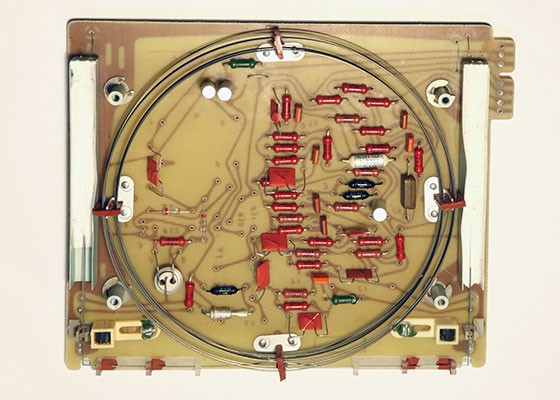
Now, you can go on about your bogus brackets until you’re blue in the face, but the fact is that this isn’t “wrong”. It has a different convention for a sensible reason and if you expect something different then it is you who are using the device wrong.
From your other comment, since having two threads seems pointless:
What do you mean “we don’t”? I just made the definition. It exists. This is why terms like “notation definition” are not actually helpful IMO, so let’s be precise and use terms that are either plain english (like “convention”) or mathematical (like “axiom”, “definition”, etc).
Yes you can. I’m not sure what you’re not understanding about Division before Addition 😂
No it isn’t! 😂
Flat wrong, as per the rules Of Maths 🙄
So stop doing wrong things and I can stop saying you’re doing it wrong 😂
If you have 1 2 litre bottle of milk, and 4 3 litre bottles of milk, even a 3rd grader can count up and tell you how many litres there are, and that any other answer is wrong. 🙄 2+3x4=2+3+3+3+3=14 correct 2+3x4=5x4=5+5+5+5=20 wrong See how the Maths doesn’t work regardless? 😂
Nope, I’ve proven it myself - that’s the beauty of Maths, that anyone at all can try it for themselves and find out. I’m guessing that you didn’t try it yourself 😂
says person failing to give a single such example 🙄
No it isn’t. I’m required to to get the Masters degree which is required to be a teacher here, and that’s the end of it.
The correct way, yes 😂
Nope, neither.
What don’t you understand about 20 being a wrong answer for 2+3x4??
Thing which results in wrong answers if disobeyed - like 2+3x4=20 - not complicated. This is what we teach to students - if you always obey all the rules then you will always get the correct answer.
Of course not, just a different function of Maths, that doesn’t involve Arithmetic at all (other than the steps along the way in doing the long division), unlike 2+3x4 🙄
Nope! Just a different rule to Arithmetic 🙄
Same thing as we’re adding the 2 in 2+3 without writing a plus (or a zero) in front of the 2 - all Arithmetic starts from zero on the number-line. Maths textbooks explicitly teach this, that we can leave the sign omitted at the start if it’s a plus.
Just like we aren’t writing the plus sign in 2+3 🙄
Nope. Same order as though we did write it in a notation using Brackets, same as we always start with adding the 2 even though we didn’t write a plus sign in 2+3.
No you can’t, because you get a wrong answer 🙄
No it doesn’t, Multiplication before Addition 🙄
You know we were writing this without brackets for several centuries before we started using brackets in Maths, right?? 😂
Nope. proven rules 🙄
No we can’t. Even a 3rd grader who is counting up can tell you that 🙄
Yes it does. Again ask the 3rd grader how many litres we have, and then try doing Addition first to get that answer 😂
No we can’t. Ask the 3rd grader, or even try it yourself with Cuisenaire rods
Nope. proven rules 🙄
Count up how many litres we have 🙄
wrong answers 😂
As per Maths textbooks 😂
rule
says person ignoring the Maths textbooks I quoted and the actual calculators giving the correct answer 🙄
Nope! proven rules as found in Maths textbooks 🙄
says person ignoring the Maths textbooks I quoted and the actual calculators giving the correct answer 🙄
Demonstrably not 😂
No they don’t! 😂
The Windows calculator is an e-calc which was written by a programmer who didn’t check that their Maths was correct. 🙄 Now try it with any actual calculator 🙄
Written by a different programmer, but one who didn’t know The Distributive Law, so even in Scientific mode it gives wrong answers to 8/2(1+3) 🙄
No it isn’t. All basic calculators obey Multiplication before Addition, 🙄 and if the programmer had tried it then they would’ve found that out
Instead of using the stack, to store the Multiplication first, like all actual calculators do 🙄
No, the dumb programmer is. All actual calculators did the Multiplication first and put the result on the stack
But actual calculators have put that result on the stack 🙄
No it wasn’t. All calculators “in the early days” used the stack
Nope, it’s just disobeying the rules of Maths because dumb programmer didn’t check their Maths was correct 🙄
And even then the stack existed 🙄
Yes it is! 😂 Again, ask the 3rd grader to count up and tell you the correct answer
knows the rules of Maths 🙄
What don’t you understand about “we don’t”?
Of the notation, not the rules 🙄
And this notation says to do paired operations first, same as if they were in Brackets. You so nearly had it 🙄
says person who keeps calling the rules “convention” 🙄
You know we have Mathematical definitions of the difference between conventions and rules, right??
Your habit of snipping replies into tiny segments and replying shortly to each makes the discussion much harder to follow. Try and collect your thoughts into something coherent, if you can.
So this is the most interesting thing you’ve said.
In mathematical notation with BODMAS order of operations, you can write your 14 litres of milk as 2 + 3 x 4, sure. But if you had right-to-left order of operations you could just write 2 + (3 x 4). So why is 2 + 3 x 4 the correct way to describe the situation? Writing out a real-life situation in mathematical notation is a question of correctly using the notational conventions to express reality.
Consider another scenario where you have two three litre bottles of milk and two three litre bottles of orange juice - how much liquid do you have in total? With BODMAS order, you could not write this as 2 + 2 x 3 = 8 litres; you’d have to insert brackets: (2 + 2) x 3 = 12 litres. But with left-to-right order you could write this as 2 + 2 x 3 = 12.
So what we have are two scenarios, where one translates readily to BODMAS order without brackets, and the other translates readily to L2R order without brackets. Neither tells you which is the superior or correct order. Neither leads to a contradiction, or problems, or incorrect results, as long as it is interpreted correctly. Yes, if you incorrectly translate my scenario as 2 + 2 x 3 with BODMAS order, you get the wrong answer. But the problem is that you translated the problem into mathematical notation using L2R order, then evaluated the expression using BODMAS order.
I’ll certainly agree that translating the problem with one convention then evaluating that with another is wrong! It leads to answers that don’t reflect reality! But of course, if you translate the problem into mathematical notation with L2R order, then evaluate it with L2R order, you get the right answer, and all is fine.
This should be easy for you to verify: pick your axiomatisation and write the proof! Or link it; that’s fine too. But you’ll have a struggle given that order of operations is about notation and that is not a (first-order) mathematical concept.
Unfortunately I suspect you think that your scenario above constitutes a proof. It does not. Here is the mathematical definition of a proof in a first order theory: It is a finite sequence of formulae in the theory, where each formula in the sequence is either an axiom of the theory or follows from one or more previous formulae by some rule of inference. The proof is then said to prove the last formula in the sequence.
There is no room for milk and bottles in a proof, unless they have first order definitions in the language of your theory. But the language of arithmetic only has the symbols for addition, multiplication, successor and zero, plus the logical symbols (quantifiers, and, or, brackets).
You’re trying to establish that it’s wrong. You’re still begging the question. Maybe you’re referring back to the milk, in which case, see above. Either way though, this is an example of a pointless comment; it’s adding nothing beyond restating what you’re already saying.
Your imaginary third-grader would be quite capable of looking at the milk and orange juice and writing down 2 + 2 x 3 = 12 and get the correct answer, if you taught him or her the right-to-left convention.
Wow, 8 separate replies from you all expressing the exact same thing, and all confidently incorrect.
https://en.wikipedia.org/wiki/Order_of_operations#Calculators
Note especially the phrase: “Many simple calculators without a stack”
https://en.wikipedia.org/wiki/Calculator_input_methods#Chain
Here is an example of a calculator manual from the 70s showing (in Example 6) that the order of operations is left-to-right: https://www.wass.net/manuals/Sinclair Executive.pdf
And the successor, one of the first affordable pocket calculators (bottom of page 8): https://www.wass.net/manuals/Sinclair Cambridge Scientific.pdf
I have no idea how you have forgotten these old, basic calculators.
So, now we’ve established that you’re confidently incorrect about “all actual calculators” having a stack, and about Windows calculator being “wrong” in its emulation of stackless calculators, let’s bring this back to the point: calculators are perfectly usable even though their order of operations is left-to-right. As I said before: it had a different convention for a sensible reason, and if you expect something different it is you who are using the device wrong. How to use the device is written in the manual, so every user of it can use it correctly.
By the way, if you want to continue this discussion, please acknowledge that you were wrong about this. This is a simple, verifiable matter of fact that you’ve been shown to be wrong about, and if you can’t cough to that then you certainly won’t cough to something more nebulous.
So, as above, the different calculators have different conventions. But let’s stick with textbooks. Because you are saying all through this that order of operations is not merely a convention, but a rule. So, it’s not actually about textbooks, is it? Yet they are, in fact, the best resource you have: your spilled milk establishes the opposite of what you want it to, so textbooks are all you have.
So consider, if all the textbooks were edited overnight to teach L2R order of operations, what would happen? Children would learn that to add 2 litres of milk to 3 bottles of 4 litres, they ought to write 2 + (3 x 4), which they would calculate and get 14. They would learn that to add the volume of two three litre bottles to two three litre bottles you would write 2 + 2 x 3 and get 12.
The textbooks are, in fact, how you can see that this is just a convention. If the textbooks changed, only what people write would change. The answers would stay the same.
But the textbooks you’ve been linking haven’t been about order of operations, but about the “primitive meaning of multiplication”. Yet, here are the axioms of arithmetic:
There is no “definition of multiplication” here because when you get down to it, definitions are things for human beings, not mathematics. Axiom 6 no more (partly) “defines multiplication” than it (partly) “defines addition.”
There’s a mathematical definition of an axiom in a first order theory, but there’s certainly no mathematical definition of a convention, because a convention is a social construct.
The definition exists. Saying “we don’t have it” doesn’t make sense. I’ve told it to you, so now you have it; you can choose to ignore it, but that’s just making the choice of convention I’m saying you’re making.
So… what is it then?
In first-order arithmetic, the + symbol is a binary operation. We’re not “leaving it out” in front of the 2, because it would make no sense to put it there.
Your repeated talk of “wrong answers” makes it sound like you’re a slave to the test. A test has right and wrong answers, after all, and if you read 2 + 2 x 3 on a test and answer 12 you’d be marked wrong. But your job is to establish not that the answer is wrong in this situation, but that if you changed the test then it would be wrong. How are you going to do that? So far you have not even tried to write down what it would mean for the test to be wrong. But I can lay out my definition of “it’s a matter of convention” easily: It’s a matter of convention because humans have agreed to do it one way even though all of maths, all totalling of milk and orange juice, everything could be done another way, and be consistent with itself and with physical reality. Maybe you can say what you find defective with that.
Nope. Rules of Maths
Neither. Multiplication is always before Addition, hence “obviously”
Nope. The vast majority of it is proven rules
Weird then how many people were able to get this right without brackets for centuries before we started using brackets in Maths (which we’ve only had for 300 years)
Tell that obvious to over half the population who get this wrong
Way less than half actually. No teachers or students ever get this wrong, only adults who have forgotten the rules, and poll after poll puts this down around 40-45% of adults.
PEMDAS isn’t obvious to “common people”? Why not? It doesn’t seem like an arbitrary convention to me…
If “×” means “groups of,” then “2+2×4” means “two plus two groups of four” which only makes sense, to me, to be read as “two plus two groups of four” rather than “two plus two groups of four”
Sure the order of operations could be arbitrarily different, but I feel like we settled on that order because it simply makes more sense intuitively.
I’m aware of the possibility that it only feels natural and intuitive to me because I was taught that way, but I at least don’t think that applies to this specific example
Everyone is taught the rules of Maths
It means repeated addition actually
No, it means 2+2+2+2+2
No they can’t
It’s because Multiplication is defined as repeated addition, so if you don’t do it before addition you get wrong answers
Clearly not if most of these answers are incorrect. If it was obvious, there wouldn’t be as many answers as there are.
It didn’t occur to me that the poll may function that way. Does it? I thought this was engagement bait in which the poll’s author lists only wrong answers as options